LIVING WORLD
People Core
Generic route-aware residents, families, cyclists, dog walkers and engineers were added as simulation agents.
This public milestone view focuses on selected changes that are useful for understanding how the world evolved.
Generic route-aware residents, families, cyclists, dog walkers and engineers were added as simulation agents.
Wildlife gained perch, cover and alert behaviours; people reacted to wet weather and nearby vehicles.
Touch controls, lifecycle input release, driving controls and the scalable Wildcat fleet were brought together as one more stable control layer.
Level-specific streets, civic space, controlled growing, operating-plant cues, inhabitants, shuttles, guided routes and system lenses were added.
Power, water, air, heat, data and waste flows gained animated state, fault/redundancy demonstrations and responder routing.
Surface, SUBTERRA, environment, vehicles and compact system state were brought under a local persistent world layer with explicit safety boundaries.
The core world retained a CPU Compatibility 3D path so simulation capability was not tied to one graphics route.
A second drivable concept vehicle was integrated while preserving the existing world, controls, SUBTERRA, Systems Alive and renderer contract.
A dedicated H9 wing added nine interactive systems exhibits covering distributed compute, power, thermal constraints, resilient communications, integrity, deployment, fault resilience and governed operations.
Ten selectable 3D concept hardware twins joined H9, bringing the Engineering Centre to 76 unique rooms and the Space wing to 19 rooms. PHOENIX V12.4 is the current public PHOENIX development line; the wider 4P3X space engineering programme extends beyond this representation.
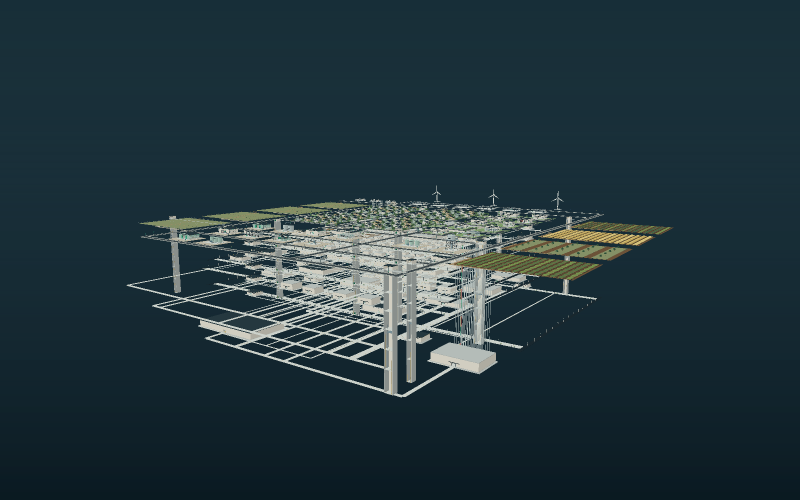
The progression was not simply “make the graphics prettier”. It increasingly separated world state, control, system simulation, rendering capability and human authority so each could be improved without pretending one layer proves another.